How Big Are Starlink Satellites Right Now?
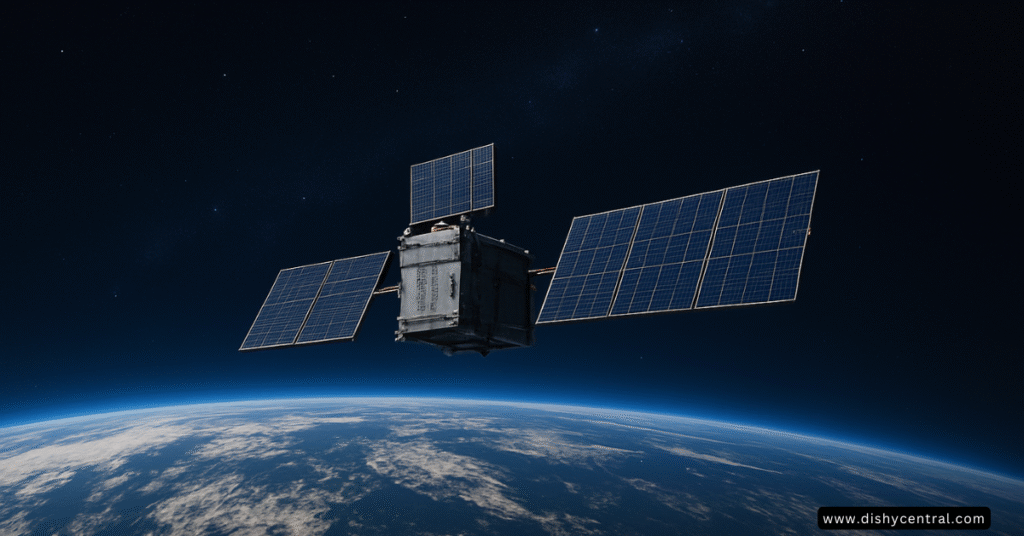
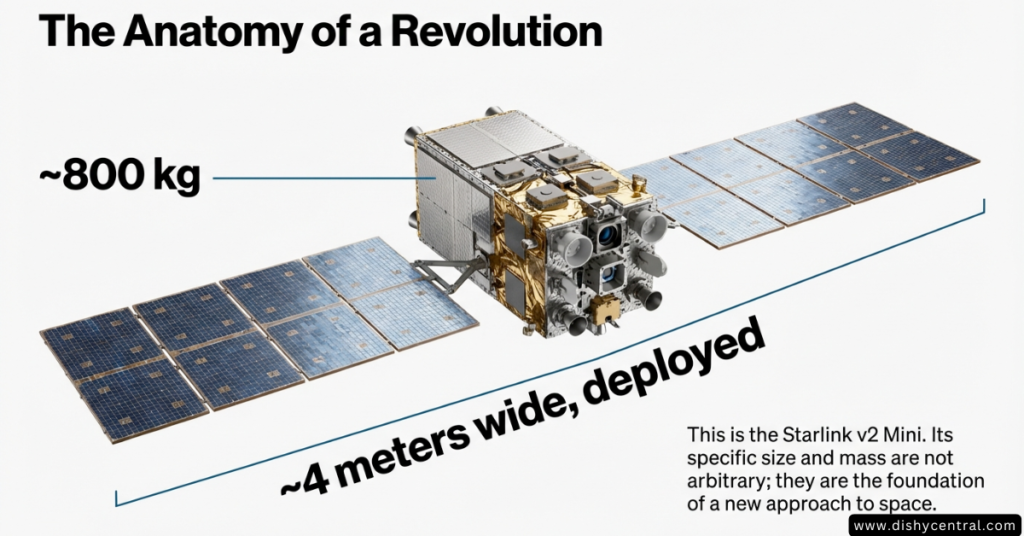
Most Starlink satellites flying today are the V2 Mini generation: about 2.8 m long and 1.4 m wide stowed, roughly 4 m wide once its solar array deploys, and somewhere between about 525 kg and 800 kg depending on which version. That range exists because SpaceX introduced a lighter “Optimized” V2 Mini partway through the generation to fit more satellites on each launch.
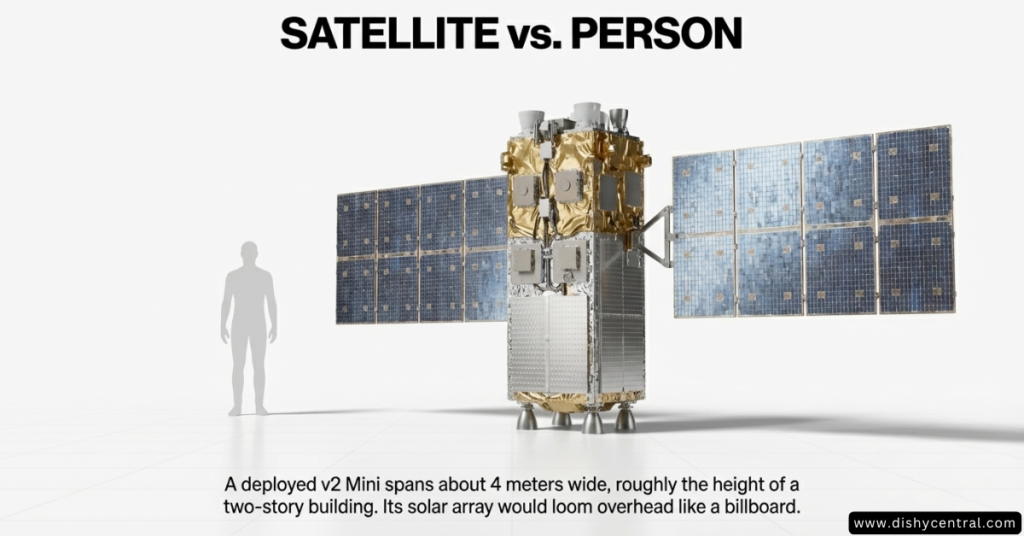
To picture it: a stowed satellite is roughly the footprint of a queen-size mattress; deployed, the solar array alone spans about as wide as a two-story house is tall. That’s what’s delivering internet to millions of users worldwide right now.
That single figure doesn’t tell the whole story, though. Starlink satellites have changed size several times since 2019, and a new generation, V3, is expected to start launching soon but hadn’t reached orbit as of mid-September 2026. Each change trades off launch efficiency, capacity, and cost.
Starlink Satellite Size: Quick Summary
- Current satellites: V2 Mini, in two variants: original (~740-800 kg) and the newer, lighter “Optimized” version (~525-575 kg)
- Early generations: V1.0 (~260 kg) and V1.5 (~295-306 kg), both much smaller and lighter
- Next generation: V3 satellites, expected to launch on Starship; official performance specs are confirmed, physical dimensions are still third-party estimates since SpaceX hasn’t published exact figures
- Why size varies: launch capacity, network capacity, cost per satellite, and how many fit on one rocket
Starlink Satellite Dimensions by Generation
Understanding how big Starlink satellites are means looking at how they’ve changed. Each generation reflects a different set of engineering trade-offs.
Starlink Satellite Specifications Comparison
| Version | Status | Mass | Deployed Width | Key Change |
|---|---|---|---|---|
| V0.9 (Tintin) | Retired prototype | ~400 kg | ~2.8 m | Initial 2018 test satellites |
| V1.0 | Mostly retired | ~260 kg | ~2.8 m | First production satellites |
| V1.5 | Operational | ~295-306 kg | ~2.8 m | Added laser inter-satellite links |
| V2 Mini (original) | Operational | ~740-800 kg | ~4.0 m | Bigger antennas, direct-to-cell capable |
| V2 Mini Optimized | Operational | ~525-575 kg | ~4.0 m | Redesigned to fit more per launch (27-29 vs 22) |
| V3 | Not yet launched (as of Sept 2026) | Not officially published (est. 1,200-2,000 kg) | Not officially published (est. ~7 m long) | 1 Tbps downlink, six 400 Gbps laser links, ~2x solar power vs V2 |
The V3 row is deliberately hedged: Starlink’s own announcement gives detailed capacity figures (1 Tbps downlink, 160 Gbps uplink, 2,048 beams each way, six 400-gigabit space lasers, roughly double the solar power of V2) but doesn’t publish exact mass or dimensions. Third-party estimates for V3’s mass range from about 1,200 kg to 2,000 kg depending on the source, so treat any specific V3 weight you see, including ours, as an estimate until SpaceX confirms it.
The growth trend is intentional where it happens: bigger satellites generally mean more bandwidth and better antennas, but only if the launch vehicle can carry enough of them to keep the cost per satellite down, which is exactly why the Optimized V2 Mini got lighter rather than heavier.
How Big Is a Starlink Satellite Compared to Everyday Objects?
Numbers alone are hard to picture, so here’s how a V2 Mini compares to familiar things.
Starlink Satellite Size Compared to…
A person. Deployed, a V2 Mini’s solar array spans about 4 meters wide, roughly the height of a two-story building laid sideways. Stowed for launch, it’s much smaller, about the size of a large dining table.
A car. At 525-800 kg depending on variant, a V2 Mini weighs somewhere between a large motorcycle and a small car, though its flat, elongated shape looks nothing like either.
Traditional satellites. Older geostationary communication satellites can be school-bus-sized and weigh several tons. Starlink satellites are deliberately much smaller, which is what makes mass production and frequent launches practical.
- Stowed: about the footprint of a queen-size mattress
- Deployed: comparable to a large residential solar panel array
- Weight: somewhere between a grand piano and a small car, depending on the variant
This compact-but-capable approach, not raw size, is what makes Starlink’s launch economics work.
Why Starlink Satellites Are Designed This Size
The “Pizza Box” Design
SpaceX engineers describe the flat-packed Starlink satellite design as similar to a stack of pizza boxes: dozens can stack efficiently inside a rocket’s payload fairing. Exactly how many depends on the generation, older, smaller V1.5 satellites could fly up to 60 per Falcon 9 launch; the larger V2 Mini carries fewer, originally 22 per launch, now 27-29 with the lighter Optimized version. Fewer satellites per launch is one of the trade-offs of a bigger, more capable satellite.
Balancing Cost, Performance, and Lifespan
- Smaller satellites: cheaper individually, more per launch, less power and bandwidth
- Larger satellites: more bandwidth and better antennas, but heavier and more expensive to launch per unit
V2 Mini (and its Optimized variant) is built for about a 5-year operational lifespan before a controlled deorbit burns it up in the atmosphere, consistent with the rest of the constellation’s design for orbital sustainability.
How Satellite Size Affects Space Operations
Orbital Altitude and Space Debris
Starlink satellites operate in low Earth orbit, roughly 340-570 km up. Their relatively small size and low altitude mean failed or retired satellites naturally deorbit and burn up in the atmosphere within a few years, rather than lingering as debris the way larger objects in higher orbits can.
Brightness and Astronomy Concerns
Early Starlink satellites reflected enough sunlight to create visible “satellite trains” that interfered with ground-based astronomy. SpaceX has made several changes in response over the generations:
- Sun visors on V1.5 satellites
- Lower-reflectivity materials on V2 Mini
- Orientation adjustments during orbit-raising to reduce reflected light
Satellite size and surface area are a real factor in how much of this reflected light reaches the ground, which is part of why the issue comes up again with each new, larger generation.
The Future: V3 and What Comes After
What Starlink Has Confirmed About V3
Starlink’s own V3 announcement focuses on capacity, not size, and gives specific, sourced numbers:
- 1 Tbps downlink capacity, about 10x V2
- 160 Gbps uplink capacity, about 22x V2
- 2,048 beams each direction (versus 192 downlink / 144 uplink on V2)
- Six 400-gigabit laser inter-satellite links per satellite
- Roughly double the solar power generation of V2’s arrays
What Starlink has not published: exact mass or dimensions. Independent estimates put V3’s mass anywhere from about 1,200 kg to 2,000 kg and its length around 7 meters, but these are outside estimates, not confirmed specifications.
Why Starship Matters
V3 satellites are built for SpaceX’s Starship, not Falcon 9; Starlink’s own materials describe deploying roughly 20x the capacity per Starship launch compared with a Falcon 9 launch of V2 satellites. As of mid-September 2026, V3 satellites had not yet reached orbit, so V2 Mini (original and Optimized) remains the satellite actually being launched and providing service today. Until Starship reaches a regular launch cadence with V3 aboard, that will continue.
Why Starlink Satellite Size Keeps Changing
Starlink’s changes in satellite size aren’t really about getting bigger for its own sake, they’re about efficiency at scale. Each generation reflects advances in launch capability, manufacturing, network demand, and (increasingly) lessons about orbital sustainability. Expect the numbers on this page to keep moving as V3 actually reaches orbit and its real-world specs become public.
Frequently Asked Questions
How big are Starlink satellites compared to traditional satellites?
Much smaller. Older geostationary communications satellites can be school-bus-sized and weigh several tons; a Starlink V2 Mini weighs 525-800 kg and is roughly the size of a large dining table when stowed. The smaller size is what makes mass production and dozens of launches a year practical.
How much does a Starlink satellite weigh?
It depends on the generation. V1.0 satellites were about 260 kg, V1.5 about 295-306 kg, and the current V2 Mini ranges from about 525 kg (Optimized) to 800 kg (original), depending on which version. V3’s weight hasn’t been officially published; estimates range from about 1,200 to 2,000 kg.
Has Starlink V3 launched yet?
Not as of mid-September 2026. V3 is designed for Starship, and while Starship itself has flown, V3 satellites had not yet reached orbit at that point. V2 Mini remains the satellite generation actually providing service.
What is the difference between V2 Mini and V2 Mini Optimized?
The Optimized version is a lighter redesign of the same V2 Mini, dropping from roughly 740-800 kg to about 525-575 kg. That weight cut lets a single Falcon 9 launch carry more satellites (27-29 instead of 22) while keeping the same core capabilities, including direct-to-cell connectivity and laser inter-satellite links.
Why are newer Starlink satellites larger?
Bigger satellites generally support more bandwidth, larger phased-array antennas, and newer capabilities like direct-to-cell connectivity. The trade-off is fewer satellites per launch, which is why SpaceX has also worked in the other direction, the Optimized V2 Mini got lighter, not heavier, specifically to fit more per rocket.