
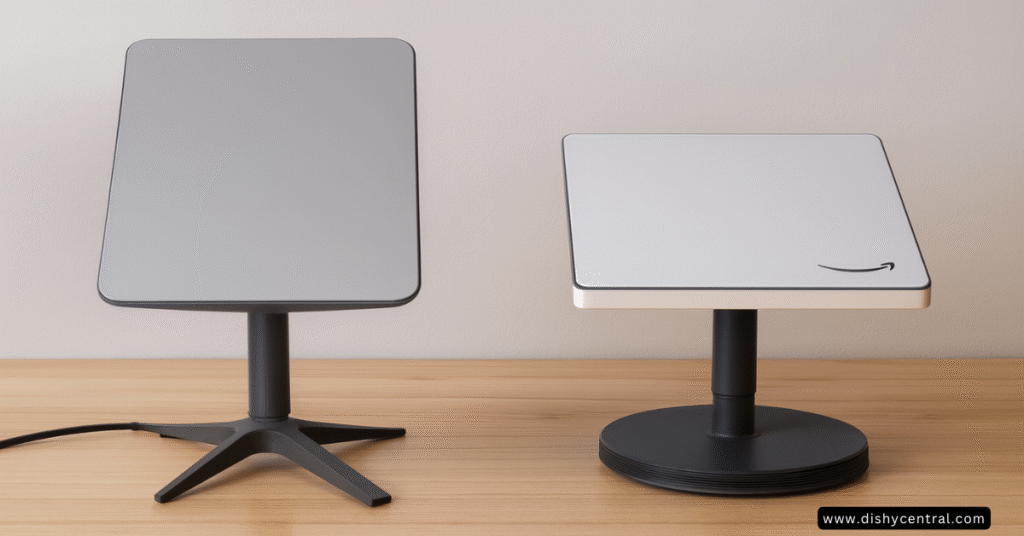
The satellite internet revolution is reshaping how we connect to the digital world, and two tech giants are leading this transformation from opposite coasts. While SpaceX’s Starlink has already captured headlines with over 7,000 satellites delivering internet to millions of users, Amazon’s Project Kuiper is quietly preparing to challenge this dominance with a $10 billion investment and the backing of the world’s largest e-commerce infrastructure.
Key Takeaways
- Starlink maintains a massive first-mover advantage with over 5 million active users across 125+ countries
- Project Kuiper promises competitive pricing with terminals under $400 and unique AWS integration
- The competition will likely result in two distinct approaches rather than a winner-take-all scenario
- Both services could revolutionize internet access for underserved communities worldwide
Executive Summary: The Dawn of a New Connectivity Era
The satellite internet space is experiencing unprecedented growth, driven by advances in low earth orbit (LEO) satellite technology and the vision of connecting every corner of our planet. This new space race isn’t just about providing internet access—it’s about fundamentally reimagining global communications infrastructure.
Thesis Statement: While Starlink currently leads in deployment with its first-mover advantage and operational network, Project Kuiper’s integration with Amazon’s ecosystem presents a formidable long-term challenge, suggesting a future defined by distinct strategic approaches rather than a simple feature-for-feature competition.
The satellite internet market, historically dominated by expensive, slow geostationary satellite services like HughesNet and Viasat, is being disrupted by these LEO constellations that promise fiber-like speeds with global coverage. This shift represents one of the most significant infrastructure developments of the 21st century, with implications extending far beyond rural broadband access.
The Contenders: A Tale of Two Billionaire Visions
SpaceX’s Starlink: The Pioneer’s Path
Elon Musk’s vision extends beyond terrestrial internet service—Starlink serves as a crucial funding mechanism for SpaceX’s ultimate goal of establishing a self-sustaining city on Mars. This ambitious scope has driven rapid deployment and aggressive market capture strategies.
First-Mover Advantage: Starlink’s early entry into the market has created substantial competitive moats. With commercial service beginning in late 2020, the constellation now boasts over 7,000 active satellites and serves more than 5 million customers across 125+ countries. This extensive real-world deployment provides invaluable operational data and user feedback that competitors cannot easily replicate.
Vertical Integration Advantage: Perhaps Starlink’s most significant strategic advantage lies in SpaceX’s control over launch capabilities. The company’s reusable Falcon 9 rockets have dramatically reduced launch costs, enabling rapid constellation deployment at a fraction of traditional satellite launch expenses. This vertical integration allows SpaceX to launch Starlink satellites multiple times per month, accelerating their market dominance.
Amazon’s Project Kuiper: The Methodical Giant
Jeff Bezos’ approach with Project Kuiper reflects Amazon’s characteristic long-term thinking and methodical execution. Rather than racing to market, Amazon has focused on foundational technology development and strategic positioning.
The “Slow and Steady” Philosophy: Amazon’s approach leverages the company’s vast resources and proven ability to operate at scale. With over 1.5 million employees and global logistics infrastructure, Amazon possesses unique advantages in manufacturing, deployment, and customer support that could prove decisive in the long term.
Massive Investment Commitment: Amazon’s $10 billion commitment to Project Kuiper represents one of the largest private infrastructure investments in history. This funding supports not just satellite manufacturing and deployment, but also the development of advanced ground infrastructure, customer terminals, and integration with Amazon Web Services (AWS).
The contrast between these approaches is telling: SpaceX moved quickly to capture market share and generate revenue, while Amazon invested years in research, development, and regulatory approval to ensure a robust, scalable foundation.
Head-to-Head: A Comprehensive Technical Breakdown
Satellite Constellations: Scale and Strategy
Starlink’s Massive Network: As of 2025, Starlink operates over 7,000 satellites in low earth orbit, with regulatory approval for up to 42,000 units. The constellation operates primarily at 340-mile altitude, optimizing for low latency and signal strength.
Project Kuiper’s Focused Approach: Amazon’s planned constellation of 3,236 satellites takes a more targeted approach, operating at slightly higher altitudes of 370-390 miles. While smaller in total scale, this constellation is designed for maximum efficiency and coverage optimization.
Orbital Strategy Implications: The altitude difference between these constellations creates interesting trade-offs. Kuiper satellites orbit higher, resulting in a 40% loss in signal power compared to Starlink’s lower-altitude network, but this higher orbit provides broader coverage per satellite, potentially requiring fewer units for global service.
Technology and Innovation: The Hardware Race
Kuiper’s “Prometheus” Advantage: Project Kuiper’s custom-designed “Prometheus” chip represents a significant technological leap, combining 5G modem capabilities, cellular base station functions, and microwave backhaul into a single processor. This integration could provide substantial performance and cost advantages.
Starlink’s Proven Phased Array Technology: Starlink has demonstrated the effectiveness of phased array antennas in real-world conditions, with over 5 million user terminals deployed globally. The system’s motorless beamforming technology enables precise satellite tracking without mechanical components.
Inter-Satellite Laser Links (ISLLs): Both constellations employ optical inter-satellite links for data transmission. Starlink has been deploying these links since September 2021, while Amazon confirmed that inter-satellite laser links worked at 100 Gbps while sending traffic “in both directions from the internet over an AWS fiber-optic connection to our ground gateway station, up to our satellites, and then down to a customer terminal” during their prototype tests.
User Terminals: The Customer Interface
The user terminal—often called “the dish”—represents the critical interface between satellite constellations and end users. Both companies have invested heavily in terminal design and manufacturing.
Starlink’s Product Range:
- Standard terminal: $599, up to 100-150 Mbps typical speeds
- High-performance terminal: $2,500, designed for enterprise use
- Starlink Mini: Compact, portable option for mobile applications
Project Kuiper’s Competitive Pricing: Amazon has announced three terminal tiers designed to undercut Starlink’s pricing:
- Standard terminal: 11-inch square design, up to 400 Mbps, projected under $400
- Ultra-compact model: 7-inch square, up to 100 Mbps, designed for IoT applications
- High-bandwidth model: 19×30-inch design for enterprise use, up to 1 Gbps
The price differential could prove significant—Amazon hopes to keep costs down so it can sell Project Kuiper dishes for less than $400, compared to Starlink’s current $599 standard terminal price.
Project Kuiper vs Starlink
Complete satellite internet comparison – Speed, pricing, availability & more
Key Insight
While Starlink dominates with 7,000+ satellites and 5M+ users, Amazon’s Project Kuiper promises competitive pricing and AWS integration, targeting late 2025 launch.
| Comparison Factor | SpaceX Starlink | Amazon Project Kuiper |
|---|---|---|
| Service Status & Availability | ||
| Current Status |
Fully Operational Active since November 2020 |
In Development Beta testing expected late 2025 |
| Global Coverage |
125+ countries Worldwide availability |
Not yet available Planned global rollout 2026 |
| Active Users |
5+ million customers |
0 (Pre-launch) |
| Satellite Constellation | ||
| Satellites in Orbit |
7,000+ active Approved for 42,000 total |
27 operational Planned: 3,236 total |
| Orbital Altitude |
340 miles (550 km) Lower = stronger signal |
370-390 miles (590-630 km) Higher = broader coverage |
| Inter-Satellite Links |
✅ Laser links active Deployed since Sept 2021 |
✅ 100 Gbps tested Proven in prototypes |
| Performance & Technology | ||
| Internet Speed |
100-250 Mbps typical Proven real-world performance |
Up to 400 Mbps promised Standard terminal target |
| Latency |
20-40ms Competitive with fiber |
TBD Expected similar to Starlink |
| Key Technology |
Phased Array Antennas Motorless beamforming |
“Prometheus” Chip 5G + cellular + backhaul integrated |
| Pricing & Equipment | ||
| Terminal Cost |
$599 standard $349-$2,500 range |
Under $400 promised Potentially more affordable |
| Monthly Service |
$120 residential $150+ mobile plans |
Not announced Expected competitive pricing |
| Data Limits |
Unlimited high-speed data No throttling |
TBD Details not released |
| Strategic Advantages | ||
| Launch Capability |
SpaceX Falcon 9 Vertical integration advantage |
Multi-vendor approach ULA, Blue Origin, SpaceX, Arianespace |
| Ecosystem Integration |
Tesla, SpaceX synergies Transportation & space focus |
Amazon Web Services Cloud computing integration |
| Investment Backing |
$6.8B estimated 2024 revenue Self-funding growth |
$10B Amazon commitment Massive upfront investment |
| Market Position | ||
| Target Market |
Consumer, Enterprise, Mobile Broad market approach |
Enterprise, IoT, Government Strategic focus areas |
| Timeline Pressure |
No regulatory deadlines Established market position |
1,600 satellites by July 2026 FCC deployment requirement |
The Customer Proposition: Performance, Pricing, and Availability
Performance: Speed and Reliability Metrics
Starlink’s Real-World Performance: With millions of active users, Starlink has demonstrated consistent performance across diverse conditions. Users typically experience speeds of 100-250 Mbps with latency around 20-40 milliseconds—competitive with many terrestrial broadband services.
Project Kuiper’s Projected Performance: While operational performance data isn’t yet available, Amazon’s terminal specifications suggest ambitious performance targets. The promise of 400 Mbps from the standard terminal would represent a significant leap over Starlink’s current capabilities.
Pricing Strategy: Different Approaches to Market Capture
Starlink’s Current Pricing Model:
- Residential service: $120 monthly + $599 equipment
- Starlink Mobile (Roam): $150+ monthly for portable service
- Business plans: $500+ monthly for enterprise applications
Project Kuiper’s Anticipated Strategy: While official pricing hasn’t been announced, industry analysts expect Amazon to leverage its economies of scale for competitive pricing. Amazon’s devices and services are usually big on value for money, and the stated intent of helping bridge digital divides implies to us that there’ll be a focus on keeping costs down.
Amazon’s approach may also include bundling opportunities with other Amazon services, potentially offering integrated packages combining satellite internet, AWS services, and Prime membership.
Availability and Global Rollout
Starlink’s Market Leadership: As of May 2025, the company had operations in over 125 countries and claimed to have over five million users. This global presence provides substantial competitive advantages in customer acquisition and regulatory relationships.
Project Kuiper’s Phased Approach: Amazon plans to begin limited beta testing in late 2025, with full commercial service rolling out in 2026. This timeline puts Project Kuiper roughly 5-6 years behind Starlink’s market entry, though Amazon’s methodical approach may enable more rapid scaling once operations begin.
The Strategic Battleground: Beyond Internet Service
Ecosystem Integration: The AWS Advantage
Perhaps Project Kuiper’s most significant competitive advantage lies in its integration with Amazon Web Services. This connection transforms satellite internet from a standalone service into a component of a comprehensive cloud infrastructure.
Enterprise and Government Applications: The combination of satellite connectivity with AWS’s cloud computing, data storage, and analytics services creates compelling value propositions for enterprise customers. Government agencies, in particular, may prefer Amazon’s infrastructure over SpaceX due to regulatory and security considerations.
IoT and Edge Computing: Kuiper’s integration with AWS enables sophisticated edge computing applications, potentially supporting everything from smart agriculture to remote industrial monitoring with seamless cloud integration.
The Launch Challenge: Diversified vs. Integrated Approaches
Starlink’s Vertical Integration: SpaceX’s control over launch capabilities provides unmatched deployment speed and cost efficiency. The company can prioritize Starlink launches and optimize rocket utilization for constellation deployment.
Project Kuiper’s Multi-Vendor Strategy: Amazon has secured launch contracts with multiple providers—United Launch Alliance, Blue Origin, Arianespace, and even competitor SpaceX. This diversification provides resilience against supply chain disruptions but may limit deployment speed and increase costs.
The regulatory pressure adds urgency to Kuiper’s deployment timeline. Continued FCC approval depends on 1,600 Kuiper satellites launching by July 27, 2026, creating significant execution pressure for Amazon’s multi-vendor launch strategy.
Market Positioning: Premium vs. Mass Market
The competition appears to be evolving toward market segmentation rather than direct competition across all segments.
Starlink’s Broad Market Approach: With services ranging from residential internet to maritime and aviation applications, Starlink has positioned itself as a comprehensive satellite internet provider targeting multiple market segments simultaneously.
Project Kuiper’s Strategic Focus: Amazon’s approach suggests targeted focus on specific high-value segments—enterprise customers, IoT applications, and integration opportunities with existing Amazon services—rather than competing directly with Starlink’s consumer-focused model.
The Bigger Picture: Societal and Ethical Considerations
Bridging the Digital Divide: Global Connectivity Goals
Both constellations share the ambitious goal of connecting underserved communities worldwide. Project Kuiper aims to bring more connectivity to every part of the planet, while Starlink has already demonstrated impact in crisis situations and remote area connectivity.
The potential societal impact extends far beyond individual internet access. Reliable connectivity could transform education, healthcare delivery, and economic opportunities in previously isolated regions, potentially affecting billions of people globally.
Space Debris and Sustainability Concerns
The rapid expansion of satellite constellations raises significant environmental and safety concerns in space.
Scale of the Challenge: When the first Starlink satellites were launched in May 2019, there were barely 2,000 active satellites in space. Today there are more than 11,000. The addition of Project Kuiper’s constellation will further increase orbital congestion.
Collision Avoidance Systems: All of the satellites in the current Starlink constellation combined perform about 50,000 collision avoidance maneuvers every six months. These automated systems prevent collisions but highlight the complexity of managing increasingly crowded orbital environments.
Deorbit and Lifecycle Management: Both companies have designed their satellites for controlled deorbit at end-of-life. Starlink satellites typically operate for 5 years before controlled deorbit, while Kuiper satellites are designed for 7-year operational lifespans.
Astronomical Impact: Dark Skies vs. Digital Connectivity
The proliferation of bright satellite constellations has created tension with the astronomical community. Ground-based observatories report significant interference from satellite streaks in long-exposure images, potentially compromising scientific research.
Both companies have implemented mitigation strategies, including darker satellite coatings and modified orbital configurations, but the fundamental tension between space-based internet infrastructure and astronomical observation remains unresolved.
Future Outlook and Predictions
The Next 5-10 Years: Market Evolution
Constellation Completion Timelines: Starlink’s deployment will likely continue at current pace, potentially reaching 20,000+ satellites by 2030. Project Kuiper faces regulatory pressure to deploy half its constellation by July 2026, creating a critical inflection point for Amazon’s ambitions.
Technology Advancement: Both systems will likely see significant improvements in satellite capabilities, ground terminal design, and network efficiency. The integration of 5G technologies and advanced signal processing could dramatically improve performance and reduce costs.
Market Maturation: As both constellations reach operational maturity, competition will likely shift from deployment speed to service quality, customer experience, and specialized applications.
Beyond Earth: Space Infrastructure Development
The success of these constellations could enable more ambitious space infrastructure projects. Reliable space-based communications networks may prove essential for lunar bases, Mars missions, and asteroid mining operations—potentially fulfilling Musk’s long-term vision while creating new markets for Amazon’s services.
The Ultimate Winner: Coexistence vs. Dominance
Rather than a winner-take-all competition, the satellite internet market appears likely to support multiple successful providers with different strengths and market focus areas.
Starlink’s Advantages:
- First-mover advantage and operational experience
- Vertical integration and cost efficiency
- Broad market penetration and brand recognition
- Proven performance in diverse conditions
Project Kuiper’s Potential:
- AWS integration and enterprise focus
- Competitive terminal pricing
- Amazon’s scale and operational expertise
- Government and enterprise customer relationships
The competition between these systems will likely drive innovation, improve service quality, and reduce costs for consumers worldwide. Rather than producing a single dominant provider, this competition may create a mature market with specialized providers serving different segments and geographic regions.
Bottom Line: The Project Kuiper vs. Starlink competition represents more than a battle for market share—it’s a race to define the future of global communications infrastructure. While Starlink’s early success is undeniable, Amazon’s patient, methodical approach and unique ecosystem advantages suggest that the ultimate outcome will be determined not by who launches fastest, but by who best serves the diverse needs of a connected world.
The real winners may be the billions of people who gain access to high-speed internet for the first time, transforming education, healthcare, and economic opportunities on a global scale. In this context, competition between Project Kuiper and Starlink isn’t just good for business—it’s essential for ensuring that space-based internet becomes a force for global equity and human progress.

