
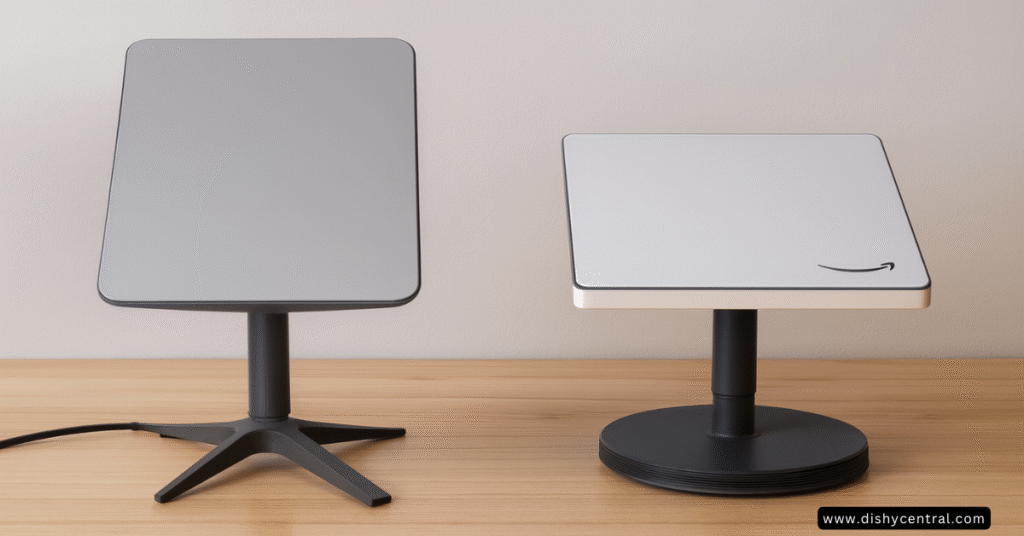
Amazon Leo is Amazon’s low-Earth-orbit satellite internet network, known as Project Kuiper until November 2025 (Amazon). It’s the first serious consumer rival to Starlink, but it is years behind: Amazon had deployed 304 satellites by May 2026, while Starlink has more than 11,000 (GeekWire). Starlink is available now in most of the world; Amazon Leo has started with enterprise and government customers.
Key Takeaways
- Project Kuiper was renamed Amazon Leo in November 2025
- Amazon plans 3,232 first-generation satellites; it had 304 in orbit by May 2026
- Three terminals announced: Leo Nano (up to 100 Mbps), Leo Pro (up to 400 Mbps) and Leo Ultra (up to 1 Gbps down)
- Consumer pricing hasn’t been announced; Amazon says it will be lower-cost than alternatives
- Starlink is far larger and available today; Amazon Leo is worth watching, not waiting for, if you need internet now
Amazon Leo vs Starlink at a Glance
| Amazon Leo | Starlink | |
|---|---|---|
| Operator | Amazon | SpaceX |
| Satellites in orbit | 304 (May 2026) | 11,000+ (Sept 2026) |
| Planned first generation | 3,232 satellites | Already operating at scale |
| Consumer service | Not yet widely available | Available in most countries |
| Top speed | Up to 1 Gbps announced (Ultra terminal) | Hundreds of Mbps; ~200 Mbps US median at peak hours |
Sources: GeekWire, May 2026; Starlink count from CelesTrak data on our live Starlink satellite tracker.
Where Amazon Leo Stands in 2026
Amazon told the FCC it would deploy half of its first-generation constellation (1,616 satellites) by July 2026 and asked for more time; the FCC waived that deadline in June 2026 (Fierce Network). Amazon has said it wants to double its launch pace, and has been providing preview service to enterprise and government customers while it builds out (GeekWire). Consumer service is expected to roll out country by country; sign-up and availability are on leo.amazon.com.
Terminals and Expected Performance
- Leo Nano: a 7-inch portable terminal, up to 100 Mbps download.
- Leo Pro: an 11-inch standard terminal, up to 400 Mbps download.
- Leo Ultra: a 20 × 30-inch enterprise terminal, up to 1 Gbps download and 400 Mbps upload.
These are Amazon’s announced figures (GeekWire). Real-world speeds will depend on how many satellites are in service and how many customers share them, which is also true of Starlink.
Pricing
Amazon hasn’t published consumer pricing. CEO Andy Jassy has said Amazon Leo will cost less than alternatives (GeekWire). For comparison, Starlink’s US Residential plans are $55, $85 and $130 a month after its June 2026 increase; see how much Starlink costs.
Which Should You Choose?
- Need internet now: Starlink. Amazon Leo isn’t broadly available to households yet.
- Already happy with Starlink: nothing to do; compare once Amazon Leo publishes prices for your area.
- Business or government buyer: ask about Amazon Leo’s enterprise service alongside Starlink Business.
- Weighing every option: see our Starlink alternatives guide.
Frequently Asked Questions
Is Project Kuiper the same as Amazon Leo?
Yes. Amazon renamed Project Kuiper to Amazon Leo in November 2025 (Amazon).
Is Amazon Leo available now?
Amazon started with enterprise and government customers. Check leo.amazon.com for consumer availability where you live.
How much will Amazon Leo cost?
Amazon hasn’t announced consumer prices, only that it aims to be cheaper than alternatives.
Will Amazon Leo be faster than Starlink?
Amazon’s announced terminal speeds (up to 400 Mbps for the standard Pro terminal) are in the same range as Starlink’s plans. Actual speeds will depend on capacity once customers are on the network.
How many satellites does Amazon Leo have?
Amazon had deployed 304 satellites by May 2026 and plans 3,232 in its first generation.
Checked September 24, 2026. Amazon Leo is changing quickly; figures here will date.